
Revaginal Vaginal Douche for Intimate Wellness
Vaginal dryness, itching, burning, irritation, and pain during intercourse may be associated with different conditions and can negatively affect everyday well-being and sexual health. However, these symptoms alone cannot identify the underlying cause. For example, the CDC guidelines on vulvovaginal candidiasis state that itching, soreness, dyspareunia, and vaginal discharge may occur in this infection, but they are not specific symptoms.
Within this context, Revaginal vaginal douche has been developed as a ready-to-use solution designed to help maintain the balance of the vaginal microenvironment. The product combines the hydrating and film-forming properties of hyaluronic acid with the acidifying action of lactic acid, helping support mucosal comfort and restore favorable physiological conditions.
What Is Revaginal Vaginal Douche?
Revaginal vaginal douche is a medical device intended for deep intimate cleansing and support of the vulvovaginal mucosa. It is indicated in cases of vulvovaginitis characterized by itching, burning, irritation, or abnormal vaginal discharge, as well as in situations involving altered vaginal pH, vaginal dryness, and vulvar pain.
The formulation is designed to gently cleanse the vaginal cavity while delivering functional ingredients that help protect and hydrate the local mucosa. It is therefore more than a simple cleansing solution: the product rationale combines intimate hygiene, hydration, and the maintenance of a physiological acidic vaginal environment.
Revaginal is available in 30 ml single-dose bottles with a disposable cannula, either individually packaged or in packs of four.
How Hyaluronic Acid and Lactic Acid Work
Hyaluronic acid is a naturally occurring substance found in human tissues and is well known for its ability to retain water and promote hydration. In vaginal formulations, it can adhere to the mucosal surface, support the protective film, and create favorable conditions for the natural renewal processes of the tissue.
The Revaginal formula contains both high- and low-molecular-weight sodium hyaluronate. These different molecular weights are used to combine strong mucosal adhesion with prolonged hydration.
Lactic acid, on the other hand, helps restore an altered vaginal pH and supports the naturally acidic vaginal environment. Vaginal pH is one of the key factors involved in maintaining the balance of the vaginal microbiota; changes in pH may be associated with alterations in the vaginal flora and the onset of discomfort.
By combining a hydrating component with an acidifying component, Revaginal vaginal douche is designed to help rebalance the vaginal microenvironment through localized action.
The complete formulation includes: water, sodium hyaluronate, lactic acid, polyvinylpyrrolidone (PVP), disodium EDTA, potassium sorbate, and sodium benzoate.
Revaginal vaginal douche is formulated to support intimate wellness when the vaginal mucosa is dry, sensitive, or affected by altered vaginal pH.
Its main indications include:
- Vaginal dryness
- Itching, burning, and irritation
- Abnormal vaginal discharge
- Vulvar pain
- Altered vaginal pH
- Discomfort associated with vulvovaginitis
The Clinical Study on Revaginal
In December 2024, the FT.CE.50 statistical report on the clinical evaluation of Revaginal vaginal douche was completed. Sponsored by Gruppo FarmaImpresa S.r.l., the study enrolled 20 women presenting vulvovaginal symptoms.
Participants had a mean age of 44.6 years, ranging from 16 to 75 years. Treatment efficacy was evaluated at baseline (T0) and after 3 weeks (T1). Participants performed one vaginal irrigation per day or every other day, according to individual needs.
Treatment effectiveness was assessed using the Vulvovaginal Symptoms Questionnaire (VSQ). The VSQ is a validated questionnaire consisting of 21 questions grouped into four domains:
- Symptoms
- Emotions
- Impact on daily life
- Sexual impact
Each positive answer scores one point. Therefore, higher scores indicate greater symptom burden and a stronger impact on quality of life.
Reduction in VSQ Score After 3 Weeks
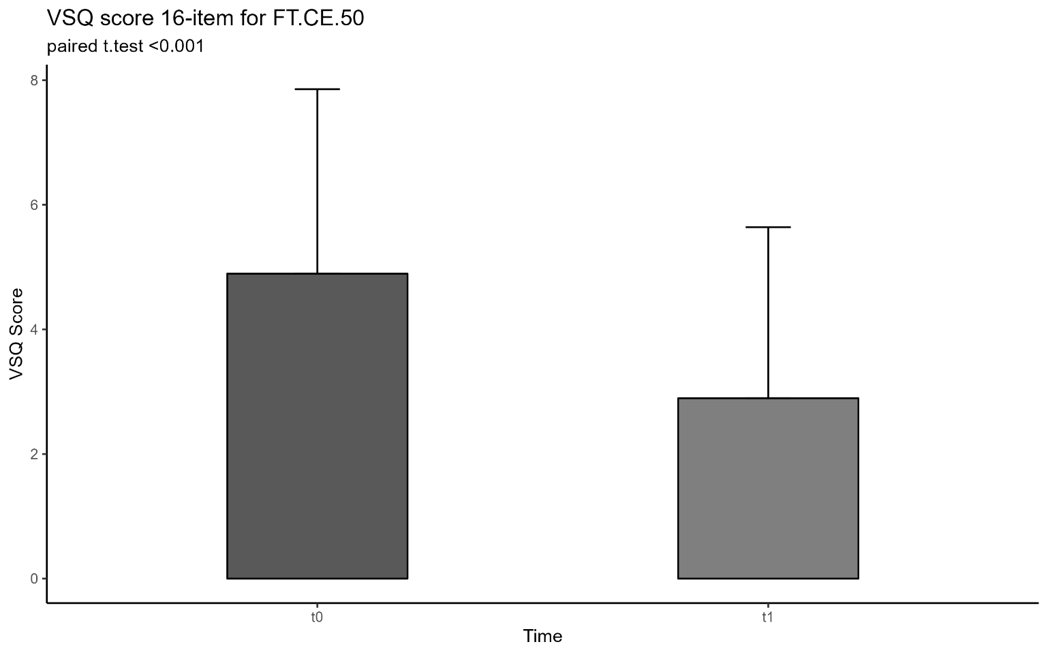
The mean VSQ score decreased from 5.05 at baseline to 2.89 after three weeks of treatment.
The average reduction was 2.16 points, with a standard deviation of 1.86 and statistical significance (p < 0.001).
These findings indicate a statistically significant reduction in overall symptom severity as measured by the questionnaire.
Category-specific analysis showed statistically significant improvements particularly in the symptom domain (p < 0.001) and the sexual impact domain (p = 0.01).
Improvement in the Main Vulvovaginal Symptoms
After 3 weeks of treatment, a greater number of participants reported that they no longer experienced some of the symptoms assessed by the VSQ questionnaire.
In particular:
- the proportion of women without itching increased from 45% to 90% (p = 0.007);
- participants without burning or stinging increased from 70% to 100% (p = 0.027);
- the absence of irritation increased from 55% to 90% (p = 0.034);
- the proportion of women reporting no vaginal discharge increased from 50% to 90% (p = 0.016).
An improvement was also observed in pain during intercourse: the number of participants reporting this symptom decreased from 11 before treatment to 3 after 3 weeks (p = 0.013).
Changes related to vaginal dryness, odor, general pain, emotional well-being, and daily activities did not reach statistical significance. Overall, the results therefore indicate improvements mainly in itching, burning, irritation, vaginal discharge, and pain during intercourse.
Revaginal for Distribution and Private Label
Are you looking for a professional product line that is ready for distribution or available as a private-label solution?
We manufacture medical devices, food supplements, and cosmetics. Revaginal vaginal douche is available to healthcare companies, distributors, and brands both as a ready-to-market product line and as a private-label product.
Revaginal combines an essential formulation, a 30 ml single-dose format, and a positioning focused on hydration, vaginal pH, and intimate discomfort. The available clinical data provide useful information on the product’s performance in a real-world sample.
The reduction in the VSQ score and the improvements observed in itching, burning, irritation, vaginal discharge, and pain during intercourse represent favorable findings.