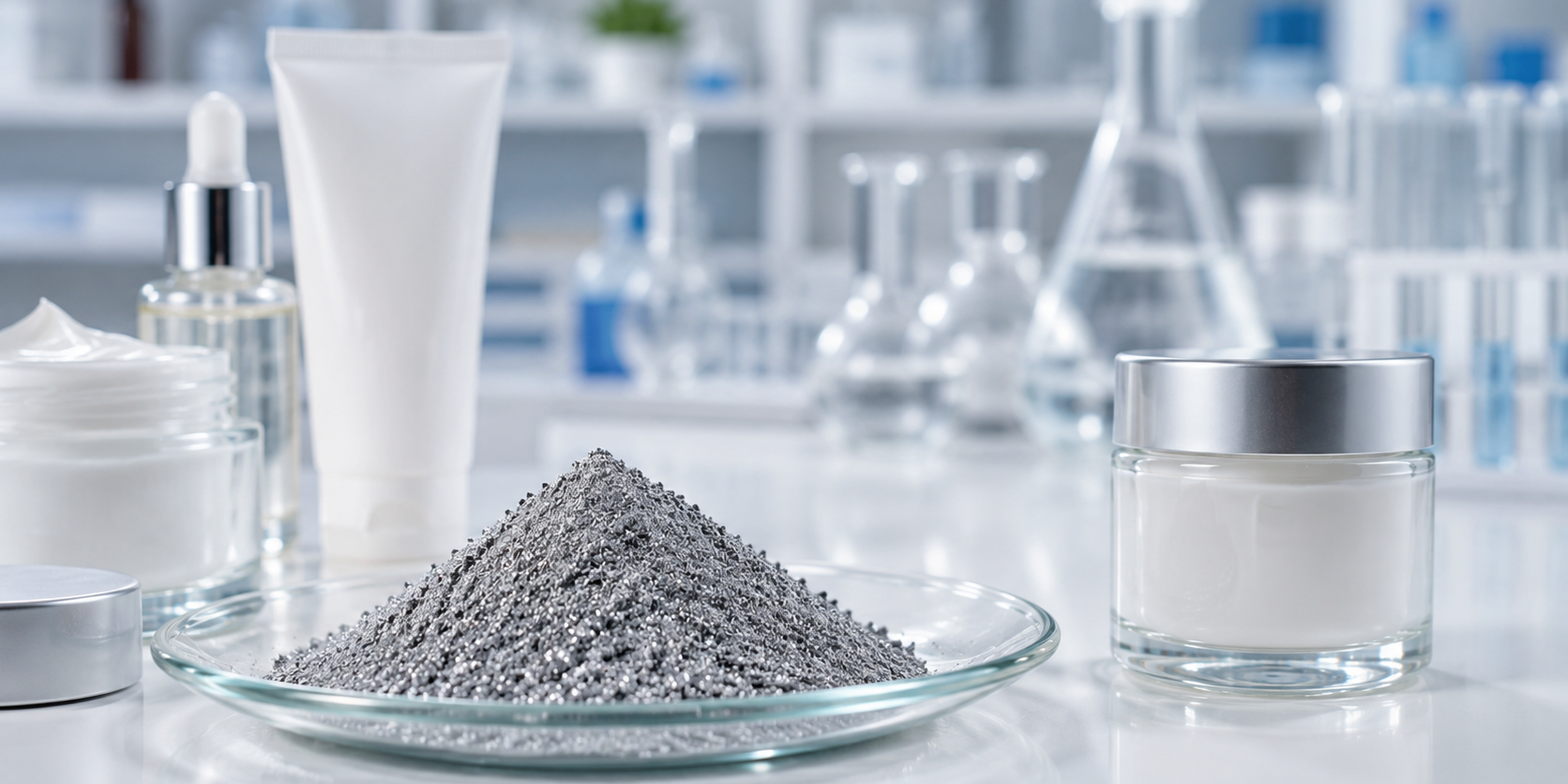
Silver powder in cosmetics is undergoing a major European regulatory shift. As of 1 May 2026, new provisions become applicable affecting the use of certain forms of silver, while new scientific data assessed by the Scientific Committee on Consumer Safety (SCCS) point to conditions of use considered safe for micronised particulate silver.
For manufacturers and Responsible Persons, it therefore becomes essential to distinguish between scientific safety assessment and the current regulatory status, verifying formulation compliance and monitoring upcoming EU updates.
What changes for silver powder in cosmetics from 1 May 2026?
The regulatory framework has been amended by Regulation (EU) 2026/78, which amends Regulation (EC) No 1223/2009 on cosmetic products, introducing provisions applicable from 1 May 2026.
For companies, it is essential to precisely identify the form of silver present in the formulation. It is not enough to generically check for the presence of “silver”: the ingredient identity, particle size, concentration and type of cosmetic product must all be considered.
New scientific data led the SCCS to assess particulate micronised silver with a diameter greater than 100 nm and less than 1 mm.
Based on the available data, which indicate no penetration through the skin, the Committee considered this form of silver safe, under the conditions assessed, up to:
- 0.2% in rinse-off cosmetic products;
- 0.3% in leave-on cosmetic products.
The assessment also considers specific conditions for other product categories, while it does not apply to the use of micronised silver in propellant-based sprays.
Does the SCCS opinion automatically change the legislation?
No. This is the central point of the update.
A favourable scientific assessment by the SCCS does not automatically result in a change to the legal conditions of use of a cosmetic ingredient. Scientific conclusions must be incorporated through the established EU legislative process before the applicable rules are formally amended.
A transitional phase has therefore arisen in which the most recent scientific evidence and the regulatory provisions are not yet fully aligned.
This principle is also relevant to the management of substances subject to new classifications and updates to the annexes of the Cosmetics Regulation.
Can products containing silver remain on the market?
The availability of favourable new scientific data does not amount to a general authorisation to keep non-compliant products on the market.
The European Commission has encouraged Member State authorities to take the importance of the new scientific evidence into account in their enforcement activities. This approach, however, does not constitute a general regulatory derogation.
Companies must therefore carefully assess the situation of their individual products and must not interpret any flexibility in enforcement as a change to the rules in force.
When could the legislation change again?
The framework for silver powder in cosmetics remains under development.
According to the information available, the possible regulation of micronised silver with particles larger than 100 nm and smaller than 1 mm should be discussed again at the Working Group on Cosmetic Products in November 2026, with a possible regulatory development in 2027.
Companies should therefore closely monitor European Commission updates without anticipating the effects of a future regulatory change.
What should cosmetics companies check?
Manufacturers and Responsible Persons should carry out a specific review of formulations containing silver, considering:
- the form and identity of the ingredient;
- particle size;
- the concentration used;
- the category and method of use of the cosmetic product;
- available technical and regulatory documentation.
It may also be necessary to review the PIF, Cosmetic Product Safety Report (CPSR), raw material specifications and supplier documentation.
Gruppo Farmaimpresa supports companies through strategic regulatory consulting for cosmetics, from feasibility assessment to documentation and product compliance review.
Scientific safety and regulatory compliance: what should companies consider?
The case of silver highlights a fundamental principle of cosmetics compliance: scientific safety and regulatory compliance do not necessarily align in timing.
From 1 May 2026, affected companies must verify the compliance of their products with the applicable provisions, taking into account both the new SCCS scientific conclusions and the possible future developments of the legislation.
Are you developing a silver-based cosmetic product?
Gruppo Farmaimpresa can support you in project scoping, regulatory review and formulation development.
Alternatively, you can browse our catalogue of ready-to-market products.
Contact us to find the solution best suited to your market.