Mivagyn vaginal tablets clinical study on vaginal pH and flora
Vaginal wellbeing depends on a delicate balance between bacterial flora, mucosal hydration, and pH. A lactobacilli-dominated flora contributes to lactic acid production and helps maintain an acidic vaginal environment that is unfavorable to the proliferation of opportunistic microorganisms.
When this balance is altered, symptoms such as the following may appear:
- itching;
- burning;
- irritation;
- vaginal dryness;
- vaginal discharge (leucorrhea);
- discomfort during intercourse;
- increased predisposition to episodes of vulvovaginitis.
In this context, Mivagyn vaginal tablets come into play, a medical device formulated to support the rebalancing of vaginal bacterial flora and natural pH. Mivagyn is a vaginal tablet based on hydrolyzed/fermented milk proteins, lactic acid, and fructo-oligosaccharides.
What is Mivagyn vaginal tablets
Mivagyn is a medical device in vaginal tablet form designed to support the restoration of vaginal pH and physiological bacterial flora.
The formulation contains:
- Hydrolyzed/fermented milk proteins, useful as functional support for the vaginal environment;
- Lactic acid, a key component for maintaining physiological acidic pH;
- Fructo-oligosaccharides (FOS), prebiotics that promote the growth of endogenous lactobacilli.
In addition, Mivagyn is indicated as a support in cases of vaginal dryness, itching, burning, irritation, alterations of the bacterial flora, and prevention/control of vulvovaginitis, including in cases of fungal infections.
Mivagyn clinical study: method and population
The clinical study enrolled 20 women, with a mean age of 40.95 years and a range between 26 and 61 years.
The evaluation was carried out at two time points:
- T0, before treatment;
- T1, after 2 weeks of treatment.
Overall, efficacy was measured using the VSQ questionnaire. Subsequently, statistical analysis used the paired t-test, after verifying data normality. The reported significance value is p<0.001, indicating a statistically significant difference between T0 and T1.
Main results: reduction in the VSQ score
The most relevant result concerns the reduction in the overall VSQ score after 2 weeks of treatment.
In the group analyzed for the 16-item score:
- Mean VSQ score at T0: 9.22 ± 3.66
- Mean VSQ score at T1: 0.61 ± 1.04
- Mean reduction: 8.61 ± 3.42 points
- Statistical significance: p<0.001
The report also shows that 65% of patients achieved complete remission of the 16-item VSQ score, while a further 20% achieved a reduction of up to 3 points or less after treatment.
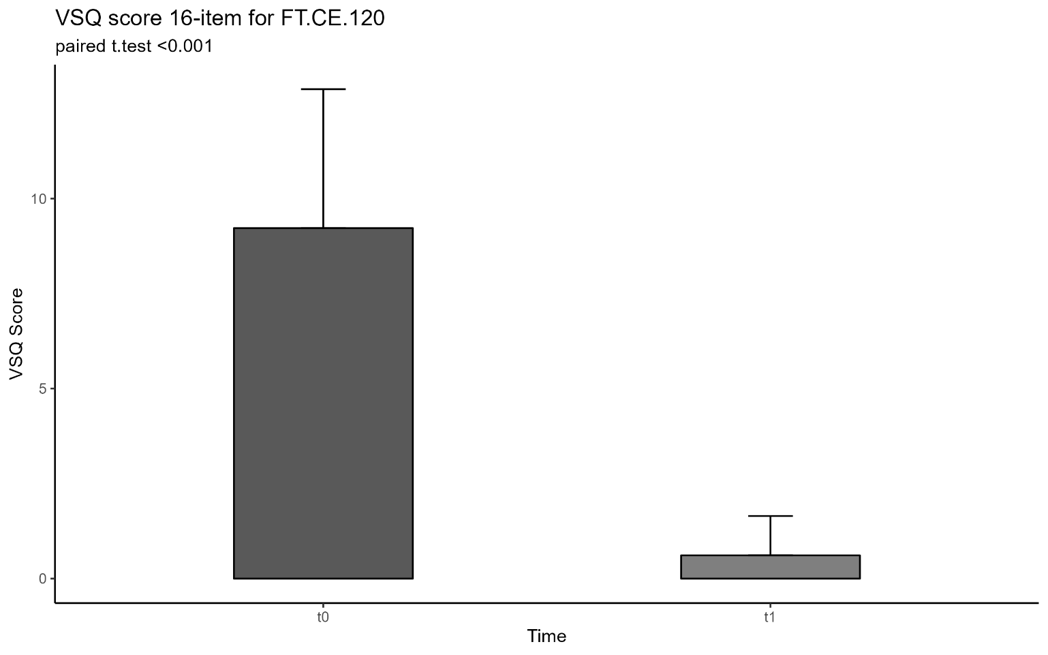
Clearly, the chart shows the reduction in the VSQ score between baseline and follow-up. At T0, the mean score indicates a clinically relevant presence of vulvovaginal symptoms; at T1, after 2 weeks of treatment, the score decreases markedly, reaching very low values. This data highlights the treatment’s impact not only on individual symptoms but also on the overall picture perceived by patients.
Symptoms assessed: itching, burning, irritation, and dryness
The study also analyzed responses relating to individual symptoms. As a result, many parameters showed a significant reduction after treatment.
Among the most notable results:
- Itching: from 80% of positive responses at T0 to 5% at T1;
- Burning or stinging: from 65% at T0 to 0% at T1;
- Pain/discomfort: from 70% at T0 to 0% at T1;
- Irritation: from 95% at T0 to 0% at T1;
- Vaginal dryness: from 70% at T0 to 0% at T1;
- Vaginal discharge: from 90% at T0 to 20% at T1;
- Odor: from 75% at T0 to 20% at T1.
Overall, these data are consistent with the rationale for using Mivagyn: supporting the rebalancing of the vaginal environment, helping to reduce symptoms associated with alterations in flora and pH.
Mivagyn vaginal tablets: B2B and private label positioning
As such, Mivagyn vaginal tablets represent an interesting solution for pharmaceutical companies, distributors, and partners interested in ready-to-market gynecological products or private label projects.
The product falls within the area of female intimate wellbeing, with a focus on:
- rebalancing vaginal bacterial flora;
- restoring physiological pH;
- support in cases of vaginal dryness;
- reduction of itching, burning, and irritation;
- prevention and control of bacterial, fungal, or yeast vulvovaginitis.
To learn more about the clinical and manufacturing area, you can also visit the Farmaimpresa section dedicated to clinical studies and the one on medical devices.
In summary, the clinical study data on FT.CE.120/Mivagyn show a significant reduction in the VSQ score after 2 weeks of treatment, with improvement in the main vulvovaginal symptoms related to altered hydration and pH imbalance.
Altogether, the reduction in the mean score from 9.22 to 0.61, the p<0.001 value, complete remission in 65% of patients, and the absence of recorded adverse events make Mivagyn a solid proposal for the gynecological market, particularly for distribution, private label, and the development of medical devices supporting female intimate wellbeing.
Looking for a gynecological medical device with clinical data to support your distribution or private label project?
Gruppo Farmaimpresa supports companies and partners in the development, manufacturing, and regulatory positioning of medical devices, supplements, and dermocosmetics.
Sources
- Erekson E.A. et al. The Vulvovaginal Symptoms Questionnaire: a questionnaire for measuring vulvovaginal symptoms in postmenopausal women.
- France M. et al. Towards a deeper understanding of the vaginal microbiota.
- Miller E.A. et al. Lactobacilli Dominance and Vaginal pH.